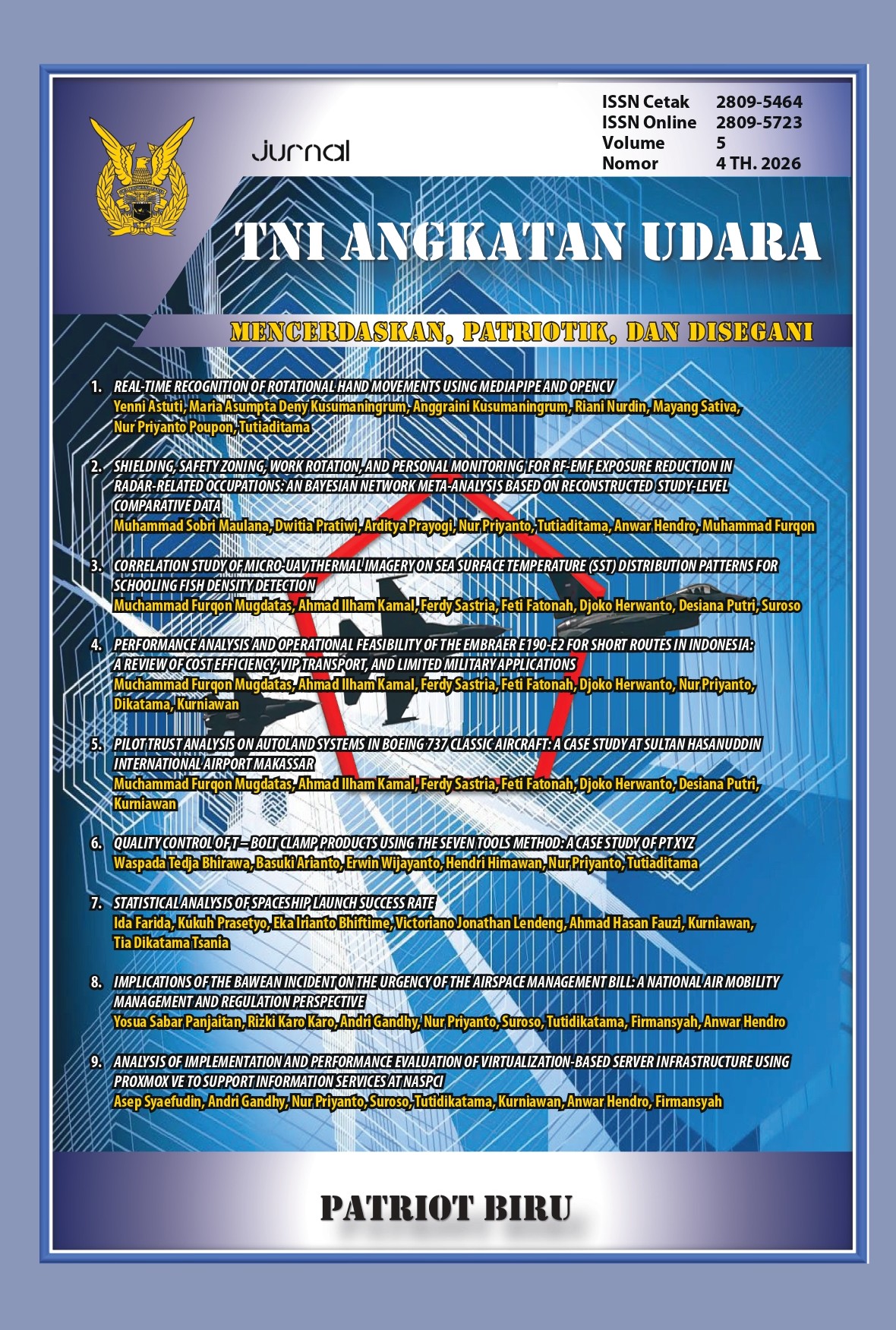
QUALITY CONTROL OF T – BOLT CLAMP PRODUCTS USING THE SEVEN TOOLS METHOD: A CASE STUDY OF PT XYZ
DOI:
https://doi.org/10.62828/nws91874Kata Kunci:
Seven Tools of Quality, T‑bolt clamp, Dimensional Deformation, Statistical Process ControlAbstrak
This research aims to identify and anticipate the dominant types of defects, so that the root causes can be analyzed and corrective actions can be proposed based on statistical quality control. The production of T‑bolt clamps at PT XYZ in 2025 revealed significant fluctuations in product quality, with an average defect rate of 2.54% from a total of 360,706 units manufactured. The peak defect rate occurred in July, reaching 4.8%, indicating systemic issues in the manufacturing process. This study aims to identify the dominant defect types, analyze their root causes, and propose corrective actions based on statistical quality control.The Seven Tools of Quality—Check Sheet, Pareto Chart, Fishbone Diagram, Histogram, Control Chart, Scatter Diagram, and Stratification—were applied to systematically evaluate production data. Results show that Dimensional Deformation was the most critical defect, accounting for 43.25% of total defects. The Fishbone Diagram revealed contributing factors across human, machine, material, method, measurement, and environmental categories. Histogram and Control Chart analyses indicated that the process was generally stable, though several periods exhibited special cause variation. The Scatter Diagram demonstrated a positive correlation (r =0.68) between workplace temperature and defect occurrence, while Stratification confirmed that Machine B produced significantly more defects than Machine A ( p<0.05).In conclusion, dimensional defects are primarily influenced by environmental conditions and machine performance. Recommended improvements include workplace temperature control, regular machine calibration, operator training, and continuous monitoring through statistical process control. These measures are expected to reduce defect rates below 3% and enhance long‑term production stability.
Unduhan
Diterbitkan
Terbitan
Bagian
Lisensi
Hak Cipta (c) 2026 Jurnal TNI Angkatan Udara

Artikel ini berlisensiCreative Commons Attribution-ShareAlike 4.0 International License.