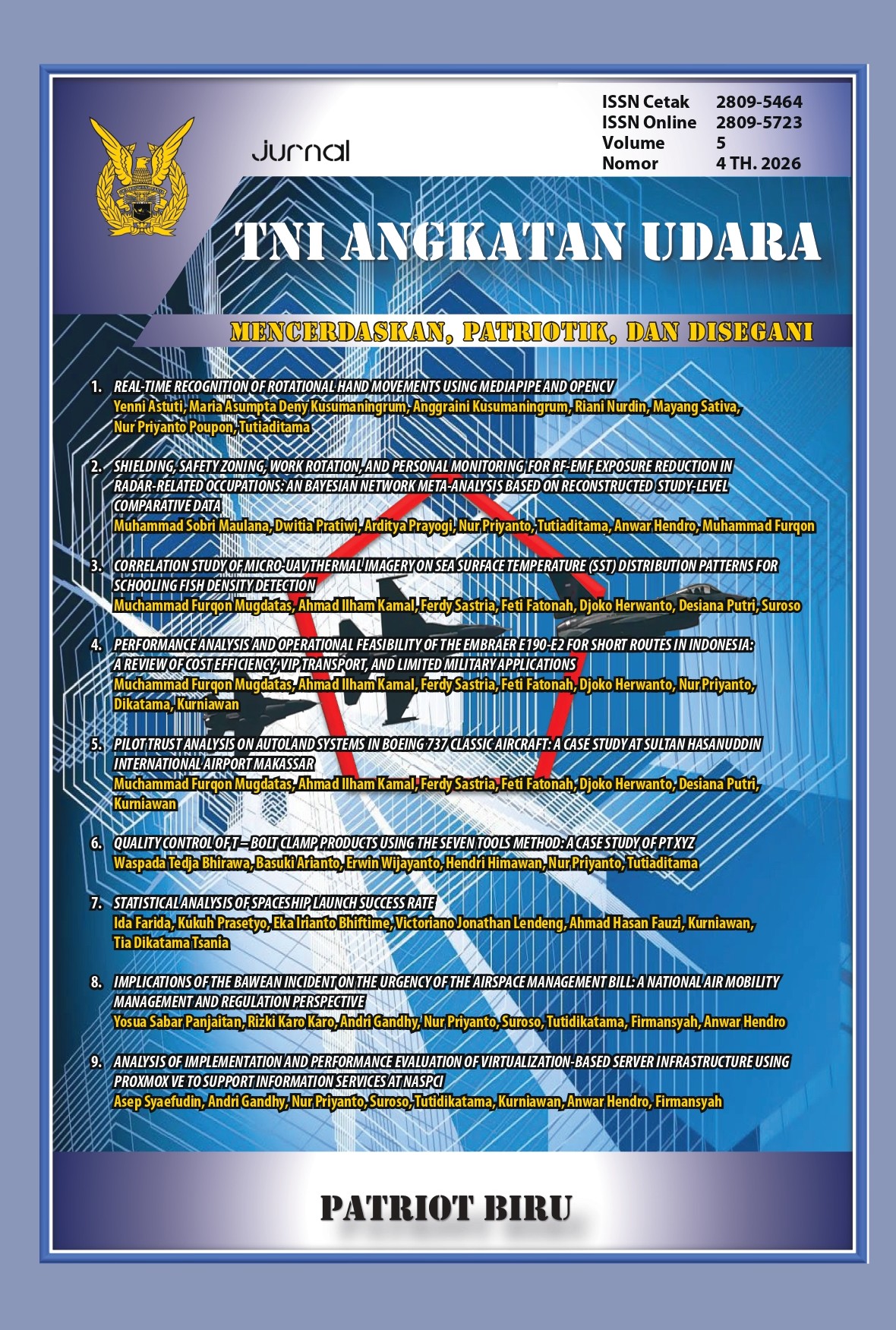
IMPLICATIONS OF THE BAWEAN INCIDENT ON THE URGENCY OF THE AIRSPACE MANAGEMENT BILL: A NATIONAL AIR MOBILITY MANAGEMENT AND REGULATION PERSPECTIVE
DOI:
https://doi.org/10.62828/9ser4f21Keywords:
Bawean Incident, Airspace Management Bill, National Air Mobility, Regulation, Aviation Safety.Abstract
The 2003 Bawean Incident, where two Indonesian Air Force (TNI AU) F-16 aircraft intercepted a US Navy F/A-18 Hornet jet on an air cover mission, demands an in-depth analysis of the alignment between Indonesia’s national airspace regulations and international air security practices. The enactment of Law No. 21 of 2025 on Airspace Management (UU PRU) marks a historical milestone in addressing this legal uncertainty. This study aims to analyze the implications of the Bawean Incident on the passage of UU PRU and examine the juridical challenges in completing its implementing regulations (RPP, Permenhub, Perpang TNI, and Perkasau) postenactment. Using a qualitative descriptive approach through literature review, this research examines air navigation coordination weaknesses and legal fragmentation. The results indicate that UU PRU successfully integrates civil aviation safety and national defense under a single legal umbrella. However, its effectiveness heavily relies on the timely drafting of derivative regulations targeted for late 2027. The major conclusion asserts the urgency of establishing an inter-agency acceleration team to overcome coordination barriers and ensure operational legal certainty across the Indonesian archipelago.
Downloads
Published
Issue
Section
License
Copyright (c) 2026 jpb

This work is licensed under a Creative Commons Attribution-ShareAlike 4.0 International License.