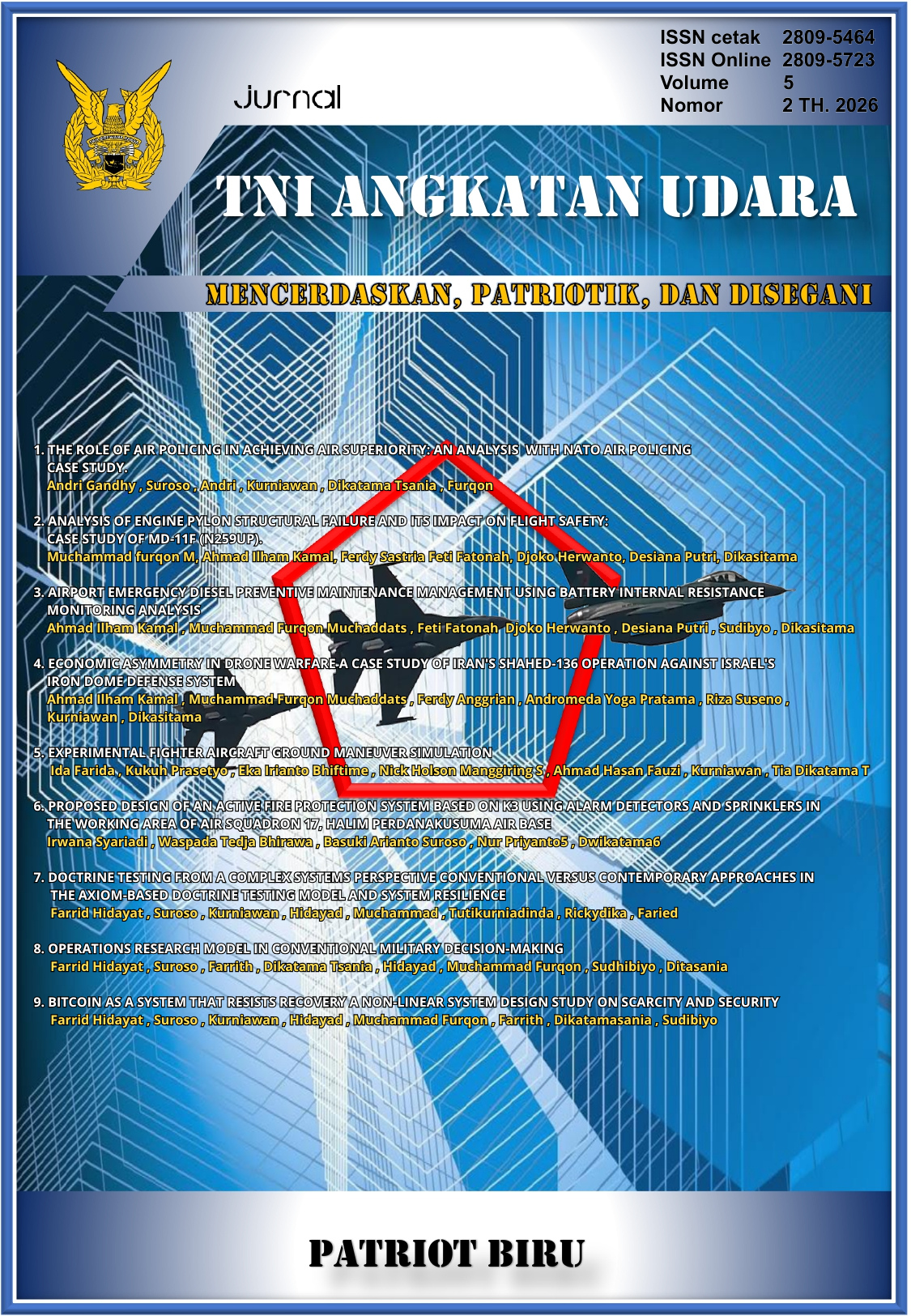
7. DOCTRINE TESTING FROM A COMPLEX SYSTEMS PERSPECTIVE CONVENTIONAL VERSUS CONTEMPORARY APPROACHES IN THE AXIOM-BASED DOCTRINE TESTING MODEL AND SYSTEM RESILIENCE
DOI:
https://doi.org/10.62828/jpb.v5i2.213Kata Kunci:
Operational Doctrine, Complex Systems, Doctrine Testing, Doctrinal Axioms, System ResilienceAbstrak
This study aims to methodologically analyze the limitations of conventional doc
trine testing approaches and compare them with contemporary complex systems-based
approaches, using doctrinal axioms and system resilience as the basis for evaluation.
Operational doctrine is traditionally tested through conventional approaches that emphasize
normative compliance, historical precedent, and limited scenario-based simulations. This
approach is based on the assumption of strategic and operational environmental stability and
the linearity of cause-and-effect relationships. However, the dynamics of contemporary
strategic and operational environments which are non-linear, adaptive, and produce emergent
effects demonstrate a methodological gap between the reality of the system encountered and
the doctrine testing mechanisms employed. The study uses a conceptual qualitative approach
through a systemic-doctrinal analysis with a comparative method of epistemic assumptions,
testing logic, and validity criteria of both approaches. The analysis shows that the conventional
approach is prone to pseudo-validity because it assesses doctrine primarily based on
procedural compliance, rather than systemic resilience to environmental change and
operational disruption. In contrast, the contemporary approach offers a more structurally
consistent evaluation framework in addressing the complexity of the strategic and operational
environment. Therefore, doctrine testing needs to be reoriented from a normative verification
model to a complex systems-based evaluation model as a structural methodological necessity.
This research contributes to the development of a doctrine evaluation methodology that is more
relevant to the study of contemporary defense doctrine and strategy.
Unduhan
Diterbitkan
Terbitan
Bagian
Lisensi
Hak Cipta (c) 2026 Jurnal TNI Angkatan Udara

Artikel ini berlisensiCreative Commons Attribution-ShareAlike 4.0 International License.